Nearly every incident that responders train for announces itself in some way, whether through dispatch traffic, alarms, or a scene that is visible on arrival. A biological event does not necessarily do any of that. It can begin quietly, present as something ordinary, and then contradict the first reasonable diagnosis anyone makes, which is why exercising against it requires testing something harder to measure than procedure.
Post Summary
- A conventional incident reveals itself and then you respond to it, while a biological incident reverses that order, so the response often begins days or weeks after the event itself.
- The 2018 Clade X exercise was built so that no combination of decisions produced a good outcome. Ten former senior officials worked the scenario, and by the end of it the model held 150 million deaths worldwide, including 15 to 20 million in the United States.
- The Dallas Ebola case of 2014 is the real-world version of the same problem. Two separate judgment calls, one in an emergency room and one on a phone call with the CDC, did more damage than any shortfall in equipment or doctrine.
- Procedures and communications plans can be tested on paper, but the thinking of the people in the room generally cannot, and that is the part most exercises leave untouched.
4 minute read, including a 2 minute readiness self-check
The soviets invent a weapon designed to confuse the people treating it
In 1989, Sergei Popov, a molecular biologist not yet 40 years old, walked up to a lectern in the USSR’s biological research complex in Obolensk, sixty miles south of Moscow. Popov had recently returned from six months of intense research at Cambridge, where his Western peers had been unaware that his education would lead to a new class of Soviet bio-weapons. “This would mean America’s medical prowess largely disappeared,” Popov said. “As if America retreated to the pre-antibiotic age when disease killed far more soldiers than shells and bullets.” Russia’s goal was to inflict catastrophic distrust and gut the U.S. from the inside out.
At the podium, Popov said he believed he had a weapon that could produce a disease Western medicine had no defense for and, even if it did, would be irrelevant. He told his peers and Soviet leaders that researchers had altered a pathogen to behave like one disease, only to introduce a second one hours or days later.
As if America retreated to the pre-antibiotic age when disease killed far more soldiers than shells and bullets.
Sergei Popov, Obolensk, 1989
Popov told Soviet leaders these were chimera weapons, named for the hybrid creature of Greek myth. The military value did not need much explaining, because Soviet leaders understood immediately that the pathogens were more than simply lethal. The greater harm would fall on the first responders and physicians trying to make sense of them, since a physician might recognize the first disease and treat it correctly, only to watch a patient develop symptoms that did not fit either the diagnosis or the triage notes.
Epidemiologists working the same outbreak would find that whatever they believed had caused the initial infection had already disappeared by the time its full effects were understood. The weapon was therefore aimed at two targets at once, the people it infected and the confidence everyone else placed in their government and its medical system.
These weapons were never deployed against Western soldiers or civilians, most likely because Soviet leaders feared they would eventually circle back to Soviet people as well. Western intelligence believes they probably still exist in a laboratory somewhere, and laboratories do occasionally leak. Such a leak is not impossible, and it is probably more likely than a killer asteroid while remaining less likely than a particularly rough flu year, which leaves a genuinely difficult problem for the people who would be expected to confront one, accidental or otherwise.

How a biological incident differs from a conventional one
With a conventional explosion, the shape of the response is generally well understood. There is wreckage, there are witnesses, and there is a medical surge of injuries and casualties. The first arriving units may not know what caused any of it, but they know with certainty that they have entered an incident. A biological event inverts nearly every one of those assumptions, and the table below sets the two side by side.
| Conventional or explosive | Biological or two-stage | |
|---|---|---|
| How it is noticed | Dispatch traffic, alarms, call volume | A pattern in an emergency room that no one has connected yet |
| When response begins | Within minutes of the event | Days or weeks after the event |
| The scene | Bounded and visible | Unbounded, extending wherever people travelled |
| Risk to responders | Managed with protective equipment and zones | Largely unknown until a second presentation appears |
| What fails first | Capacity and logistics | Diagnosis, followed by public trust |
| The hardest call | Allocating finite resources | Acting while the picture is still incomplete |
How Clade X was designed to test problems with no apparent solution
In 2018, U.S. government leaders and Johns Hopkins Center for Health Security researchers tested a similar theory and modeled a war game called Clade X. In it, terrorists release a biological weapon in Germany where it quickly spreads around the world through air and sea ports.
For medical teams, the tabletop exercise reveals that as the disease spreads, so does panic. The hospital systems collapse from surge volume, fear, and distrust.
For political leaders, a PR and humanitarian crisis unfolds as migrants from South America try to get to Puerto Rico on makeshift boats. The U.S. Coast Guard, under orders to secure the borders, intercede and realize they have no choice but to turn the boats away or sink them to prevent hundreds of potentially infected migrants from landing on U.S. territory.
“Puerto Rico has only a few isolation beds,” says Julie Gerberding, former director of CDC. The migrants would overwhelm the medical system.
Cases surface in Frankfurt, Germany and Caracas, Venezuela. By the time the committee convenes there are already more than 400 cases and roughly 50 deaths, and nobody involved yet understands that the release was deliberate.
As the disease spreads, so does public panic, and hospital systems begin to fail under a combination of surge volume, fear, and distrust rather than case counts alone. Gerberding argues that travel restrictions are “not effective, impractical and potentially harmful,” a position that is defensible on the medicine and very difficult to sell politically at the same moment.
The Coast Guard reports boats carrying sick Venezuelan refugees approaching Puerto Rico, which has only a few isolation beds available. Every option on the table carries serious costs, whether that means turning the boats away, accepting them, or declining to decide at all. O’Toole presses the group on the consequences of live video showing families on leaking boats, and Daschle warns that the situation is a catastrophe in the making.
In the scenario, the ultimate fate of the migrants is never revealed because a series of other, larger cascading crises overwhelm leaders. Large cities globally fall into riots and looting, 115 million Americans die, and then suddenly the war game ends because the world is in chaos.
In Clade X, the Secretary of Homeland Security, played by former official Tara O’Toole, stresses the bad optics of live video of families on leaking boats forced out into the open ocean. Tom Daschle, playing the Senate Majority leader warns this a catastrophe.
The tabletop was designed to test America’s readiness and national sovereignty. From the scenario, conclusions of the top challenges are:
- Early refugee flows are indicators of failed states.
- U.S. maritime borders are a vulnerable underbelly to quarantine planning.
- America’s sovereign borders are at risk of being overrun, but must never be overrun.
Why officials call this a wicked problem
High-ranking officials tasked with solving such a problem call these “Wicked Problems”, a military term borrowed from system theory for “a problem without a solution”. The term describes a problem so dynamic and complex that by the time it reveals itself the conditions and challenges have already changed. Biological attacks, with aerosolized pathogens, are one such wicked problem and the worst-case scenario as breathing becomes the primary dispersal method, which kills law enforcement, nurses, and other first responders who are best equipped to help.
Part of a tabletop exercise is to test against processes and systems, such as to how to communicate with the public and test command structure. But another less-discussed part is about training judgment.
The Ebola virus and failed judgement in Dallas, 2014
In September 2014, Thomas Eric Duncan, a Liberian man, arrived at Dallas-Forth Worth International Airport by way of Brussels unaware he was infected with Ebola Hemorrhagic Fever Virus (EHFV). Feeling ill, he went to Dallas Presbyterian ER where doctors diagnosed him with a sinus infection. He was prescribed useless antibiotics and told take Tylenol.
Days later, an ambulance wheeled him back into the ER, but this time he was bleeding from the eyes. A common symptom of Ebola. In 2014, Ebola wasn’t unknown. When Duncan arrived at DFW, the Ebola epidemic in West Africa, where Duncan was from, had already killed 3,000 people and been front-page news for weeks.
Duncan, a Liberian man, flies from Monrovia to Brussels and then on to Washington Dulles and Dallas/Fort Worth, unaware that he is infected with Ebola. By this point the epidemic in West Africa has already killed roughly 3,000 people and has been front-page news for several weeks.
Feeling ill, Duncan arrives at the emergency room of Texas Health Presbyterian late at night. He is diagnosed with sinusitis and abdominal pain, prescribed antibiotics that would do nothing against a virus, and discharged at 3:37 in the morning. His travel history was recorded in the building, but it did not reach the person making the decision about his care.
Duncan returns by ambulance on September 28 and is admitted. On September 30 the CDC confirms him as the first case diagnosed in the United States, and he dies on October 8, 2014.
Nina Pham, a 26-year-old nurse who had cared for Duncan, tests positive and becomes the first person to contract Ebola within the United States. She later recovered.
Amber Joy Vinson, a 29-year-old nurse who had also cared for Duncan, had flown to Cleveland for a wedding on October 10. Before her return flight she reported a temperature of 99.5 degrees to the CDC, and because the agency’s fever threshold was 100.4 degrees she was not told that she could not travel. She boarded a commercial Frontier flight back to Dallas on October 13 and tested positive two days later. She also recovered.
CDC Director Tom Frieden later acknowledged the problem directly, noting that because she belonged to a group known to have been exposed, she should not have traveled on a commercial airline at all. The threshold had been applied exactly as written, and the result was still wrong.
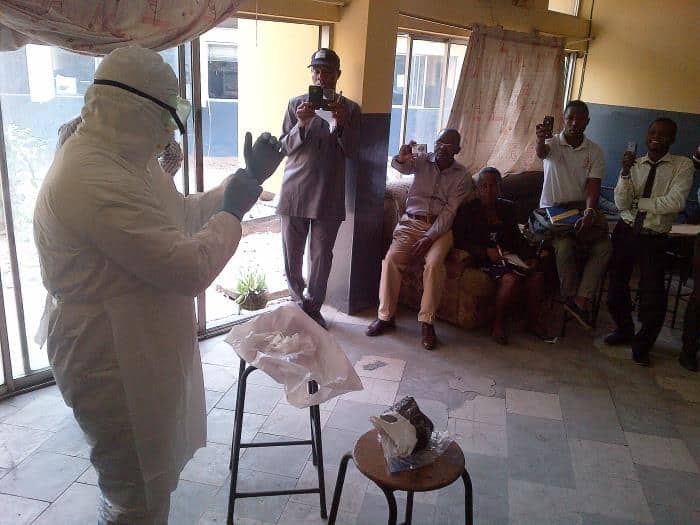
Because at that point she was in a group of individuals known to have exposure to Ebola, she should not have traveled on a commercial airline.
CDC Director Tom Frieden, October 2014
Hospital officials contacted the CDC who later confirmed Duncan as the first U.S. case of EHFV. One of his nurses, Amber Joy Vincent, had plane tickets to Cleveland to attend a wedding. She asked the CDC whether she should travel, and, after reporting a slight fever of 99.5, CDC officials noted she was below the threshold of 100.4 and cleared her to fly. Upon returning from Ohio, she tested positive for Ebola, which is spread only through bodily fluids. When the public learned, there was outrage the CDC struggled to walk back. CDC Director Tom Frieden said she was not vomiting or bleeding, and was thus cleared, but later apologized. Another nurse was later diagnosed, too, and both her and Duncan received first-class care and recovered, but Duncan died on October 8, 2014 to become the first U.S. death of EHFV.
Is your plan ready for a two-stage incident?
The eight statements below describe capabilities that a two-stage event tends to test. Check the ones that are true of your organization today rather than the ones you intend to address this year.
Two-stage incident readiness self-check
Nothing is stored or submitted, and your answers remain on this page.
0 of 8
Check the statements above to see where your organization stands.
The Soviet Union's Chimera weapons have thankfully never been released, but two-headed, protracted problems occur regularly. They come in the form of unknown hazmat leaks in a small town or a possible terror plot in a large city. VPC provides tabletop exercises that can test these systems and responses, but our tabletops are designed to test the judgment of everyone in the room on a variety of problems unique to your partners and situation, too.
The likelihood of an event like this in any one community remains relatively rare. But as COVID taught all of us, the likelihood of a problem in one place spreading to another can be swift and complete in short order.
Tabletop exercises that test judgment
VPC designs tabletop exercises around the problems your agency and your partners would realistically face, including the ones that have no clean answer. We build the scenario, facilitate the room, and document where decisions broke down so that the findings are usable afterward.
Talk to us about an exerciseCommon questions
What was the Clade X exercise?
Clade X was a day-long tabletop exercise conducted by the Johns Hopkins Center for Health Security on May 15, 2018. Ten former senior U.S. officials played a National Security Council responding to an engineered pathogen released by a fictional group. By the end of the scenario, which covered twenty months of modeled time, it held 150 million deaths worldwide and 15 to 20 million in the United States.
What is a wicked problem in emergency management?
A wicked problem is one that offers trade-offs rather than solutions, a term borrowed from systems theory. Such a problem is dynamic enough that by the time it is understood, its conditions have already changed. Biological incidents, cascading infrastructure failures, and large-scale civil unrest all tend to qualify.
Why test judgment rather than procedures?
Procedures can be audited on paper, while judgment only becomes visible under ambiguity. The Dallas Ebola case illustrates the distinction clearly, because the CDC’s fever threshold was applied correctly and the outcome was still wrong. An exercise that confirms notification trees will never surface a failure of that kind.
How long should a tabletop exercise take?
A focused tabletop generally runs two to four hours, and Clade X ran a full day because it involved national policy and ten principals. Length matters considerably less than whether the scenario forces participants into a decision they cannot resolve with a checklist.
Sources
- Johns Hopkins Center for Health Security, Clade X tabletop exercise and named participants.
- Global Health NOW, “Clade X: A Mock, Yet Entirely Plausible, Pandemic.”
- Federation of American Scientists, the Soviet biological weapons program.
- NPR, reporting on Thomas Eric Duncan.
- ABC News, reporting on the CDC travel clearance and Tom Frieden’s statement.