Analyzing federal data on rail tank car safety, from the stencil on the car to the first hour after a derailment
On June 11, 2026, a Norfolk Southern train bound from Fort Wayne, Indiana, to Chattanooga derailed 29 cars near Wartburg, Tennessee. Every one of the 19 hazmat tank cars that left the track was a DOT-117, the design federal regulators required after the oil-train fires of 2013 and 2014. Three of them breached anyway. About 107,000 gallons of alcohol fed a fire that burned for three days, and a one-mile evacuation zone stayed in place for six and a half hours.
Sixteen of those 19 cars held, which is what the newer design is supposed to do: buy time and reduce the number of cars that fail. What happens with that time still depends on people. The crew holds the paperwork, the 911 dispatcher takes the railroad’s call, and a fire officer has to size up a pile of cars in the dark. Then a hospital sees the first patients, and an elected official explains it all on camera.
This guide is for those people: fire and EMS, hazmat teams, dispatchers, emergency managers, hospital emergency planners and local officials, with a focus on Indiana and the Midwest. It covers how to read a rail tank car from the ground, what changed in federal rules through 2026, how to get a train’s consist in the first hour, and how to plan, communicate and exercise before a derailment happens in your county. Every figure is linked to its source, and the accident counts are our own analysis of Federal Railroad Administration data.
Post Summary
- Indiana logs about 16 rail accidents a year involving trains that carry hazmat cars, and five Midwest states account for one in five U.S. rail accidents that release hazardous materials.
- About 76% of the tank cars hauling flammable liquids are now DOT-117s or retrofits. Roughly 17,000 older cars still have to leave that service by May 1, 2029, faster than shops are converting them.
- New and retrofitted DOT-117s breached in 2026 derailments in Texas and Tennessee, and after a 2024 North Dakota derailment the NTSB said retrofits haven’t matched the new cars.
- Since June 2026, railroads must be able to push a hazmat train’s consist to responders electronically and call the local 911 center right after an accident.
- The Emergency Response Guidebook isolates a burning tank car for one mile if it holds a flammable gas or anhydrous ammonia, and half a mile for crude oil, ethanol or chlorine.
- East Palestine’s most consequential decision came on day three, and the NTSB traced it to expert advice that never reached the incident commander.
About a 30 minute read, including a rail tabletop exercise you can run with your county.
In this guide
- How much hazmat moves by rail, and how often it escapes
- DOT-111, CPC-1232 and DOT-117: how the rail tank car changed
- How to read a rail tank car from the ground
- Richmond, Wartburg and Bordulac: the limits of the DOT-117
- Getting the train consist in the first hour
- BLEVEs, heat-induced tears and how far to pull back
- Vent and burn: a 13-minute decision at East Palestine
- When patients reach the hospital before the consist does
- Talking to a town that can see the smoke
- Planning for the train before it derails in your county
- A rail tank car tabletop exercise for your county
- Rail tank car questions responders ask
How much hazmat moves by rail, and how often it escapes
Railroads don’t publish hazmat volumes by route, so most communities have only a rough sense of what passes through. The national picture is clearer. The Bureau of Transportation Statistics counted about 851,000 rail tank car shipments of flammable liquids in 2025, including 413,546 shipments of ethanol, the most since it began collecting the data.
The mix has shifted. According to EIA, crude oil by rail averaged about 1.05 million barrels a day in 2014, the year after Lac-Mégantic, and fell to about 311,000 barrels a day in 2025. Ethanol went the other way, reaching a record of about 745,000 barrels a day in 2025. Railroads now move more than twice as much ethanol as crude oil, much of it from the Corn Belt.
The industry’s headline safety number is that more than 99.99% of hazmat shipments arrive without a release caused by a train accident. That figure is accurate on its own terms. It counts shipments rather than consequences, and it leaves out releases that don’t involve an accident, such as a leaking valve. For a responder, the more useful question is how often a train accident actually puts product on the ground, and how many people end up leaving their homes when it does.
| Year | Accidents with a hazmat release | Cars that released | People evacuated |
|---|---|---|---|
| 2016 | 14 | 20 | 1,095 |
| 2017 | 13 | 38 | 1,007 |
| 2018 | 20 | 34 | 57 |
| 2019 | 15 | 27 | 2,438 |
| 2020 | 20 | 27 | 1,070 |
| 2021 | 13 | 29 | 36 |
| 2022 | 13 | 48 | 506 |
| 2023 | 12 | 36 | 2,355 |
| 2024 | 11 | 22 | 300 |
| 2025 | 15 | 24 | 380 |
| 2026 (partial) | 5 | 5 | 0 |
Releases are rare, about a dozen a year nationwide. The evacuation column swings wildly because one bad derailment in a populated place outweighs years of minor ones. An August 2025 investigation by the Associated Press and the Howard Center counted 57 derailments in a decade that released more than 1,000 gallons, 26 of which led to evacuations, and found that fewer than one in five fire departments has a hazmat team.
Indiana and the Midwest
In Hazmat Technician training is critical nationally, but absolutely necessary in the Midwest, we noted that over 20% of U.S. hazmat transportation incidents since 2013 occurred in Illinois, Indiana, Kentucky, Ohio and Michigan. The rail data says the same thing. Of the 165 U.S. rail accidents that released hazardous materials from 2015 through mid-2026, 33 happened in those five states.
Three Class I railroads, CSX, Norfolk Southern and CN, run main lines through Indiana, along with 39 regional and short-line railroads, according to INDOT. Norfolk Southern alone operates about 1,440 miles of track in the state. From 2018 through 2025, Indiana averaged about 16 reportable rail accidents a year involving trains that carried hazmat cars. Most released nothing. Eleven Indiana accidents since 2012 did, including a 2012 derailment in Ligonier that evacuated 54 people and a 2018 derailment in Princeton that evacuated 32.
The state doesn’t always know which trains are coming. In 2023, WISH-TV reported that about a dozen high-hazard flammable trains cross Indiana every week. Those are trains with 20 or more loaded tank cars of flammable liquid in a row, or 35 anywhere in the train, and they are the only ones railroads must tell the state about. “We don’t get a specific notification ‘Today is when it happens,’” Indiana Fire Marshal Steve Jones told the station.
DOT-111, CPC-1232 and DOT-117: how the rail tank car changed
A rail tank car is a steel tank mounted on a railcar frame that carries liquids or gases in bulk, from about 6,500 to more than 30,000 gallons. Two families matter most to responders. Non-pressure cars, which the ERG calls low-pressure or general service cars, carry liquids such as crude oil, ethanol and acids. Pressure cars carry liquefied gases such as propane, anhydrous ammonia, chlorine and vinyl chloride, and are built with thicker tanks.
For decades the workhorse non-pressure car was the DOT-111. The industry began building an improved version in October 2011 under its Casualty Prevention Circular 1232, so those cars are called CPC-1232s. Then came the derailments that changed the rules. At Lac-Mégantic, Quebec, in July 2013, 63 of a runaway train’s 72 tank cars derailed and the fire killed 47 people. Casselton, North Dakota, followed that December, and Lynchburg, Virginia, in 2014. In May 2015 the U.S. DOT created the DOT-117 in its high-hazard flammable train rule. Congress then extended the phase-out of older cars to every DOT-111 and CPC-1232 in flammable-liquid service, whatever train it rides in.
| Feature | DOT-111 (legacy) | CPC-1232 | DOT-117 (new build, 117J) |
|---|---|---|---|
| Shell | 7/16 in. steel (typical) | 1/2 in. TC-128B steel, or 7/16 in. if jacketed | 9/16 in. TC-128B steel |
| Head shields | Optional | At least 1/2 in., half- or full-height | Full-height, 1/2 in. |
| Thermal protection and jacket | Optional | Jacket optional | Required: survives a 100-minute pool fire and 30-minute torch fire; 11-gauge steel jacket |
| Top fittings | Protection optional on older cars | Protective housing | Protected |
| Bottom outlet | Optional; handle stays on | Yes | Optional; handle removed or locked out in transit |
| Out of flammable-liquid service | Crude: 2018. Ethanol: May 1, 2023. All others: by May 1, 2029 | Crude and ethanol: by May 1, 2025. All others: by May 1, 2029 | Current standard |
Retrofitted cars carry a different stencil. A DOT-117R is an existing DOT-111 or CPC-1232 rebuilt with head shields, thermal protection, a jacket and top fittings protection, but it keeps its original, thinner shell. A DOT-117P is an existing car that meets the DOT-117 performance standard by another route. The difference matters, as the next section shows.
Pressure cars were never part of the phase-out. Their rules come from the same part of the federal code:
| Pressure car class | Insulation | Bottom outlet | Test pressure |
|---|---|---|---|
| DOT-105 | Required | Not allowed | 100–600 psig |
| DOT-112 | Optional | Not allowed | 200–500 psig |
| DOT-114 | Optional | Optional | 340 or 400 psig |
How to read a rail tank car from the ground
Federal rules require a hazmat rail car to be placarded on each side and each end, with its four-digit UN number on the placard or on an orange panel. That is the first thing to read, through binoculars and from upwind. Placards can burn, though. At East Palestine illegible placards slowed identification, and the NTSB asked PHMSA for placards that survive fire. A tank car carries three other sets of markings that help when the placard is gone or doesn’t tell the whole story.
- Reporting marks and number, such as GATX 123456, are painted on both sides and ends. They identify the specific car, so you can look it up in the consist or in AskRail even when derailed cars are out of order.
- The specification stencil is near the reporting marks on both sides. It tells you what kind of tank you are looking at (decoded below).
- The car’s fittings. A pressure car keeps all of its valves under a bolted protective housing on top, and DOT-105 and DOT-112 cars have no bottom outlet. A protective housing alone doesn’t prove a pressure car, because CPC-1232s and DOT-117s have top fittings protection too, so check underneath for a bottom outlet valve and confirm with the stencil. Don’t read “non-pressure” as “no pressure,” either. Non-pressure cars with relief devices set at 75 to 165 psig can hold real pressure in a fire.
The specification stencil reads left to right. Take DOT-117J100W:
- DOT is the authorizing agency (TC for Transport Canada, AAR for industry classes).
- 117 is the class. 111 and 117 are non-pressure; 105, 112 and 114 are pressure cars.
- J is the delimiter letter. On a 117, J means built new, R means retrofitted and P means it meets the performance standard. On other classes, J means a jacketed thermal protection system plus head protection, T means sprayed-on thermal protection plus head protection, S means head protection only, and A means nothing in particular.
- 100 is the tank test pressure in psig. Non-pressure cars test at 60 or 100; pressure cars run from 100 to 600.
- W means fusion-welded. An I in that spot marks an interim design for poison or toxic inhalation hazard cars built from 2009 to 2020; those cars must be re-stenciled as H cars by the end of 2027. On older non-pressure cars, a digit after the W tells you about the tank: W1, W3 and W6 may have a bottom outlet, while W2, W4, W5 and W7 do not. DOT-117s don’t carry a digit.
So a vinyl chloride car stenciled DOT-105J300W, like the five at East Palestine, is an insulated pressure car with jacketed thermal protection and head protection, tested to 300 psig. That is a far stronger container than the DOT-111 next to it.
Once you have a UN number, the Emergency Response Guidebook (ERG2024) gives the initial isolation distance if a tank car is involved in a fire. Many references, and a lot of training slides, say “one mile” for every tank car. ERG2024 doesn’t:
| UN number | Material | ERG guide | Isolate if a rail tank car is in a fire |
|---|---|---|---|
| 1075 | Liquefied petroleum gas (propane, butane) | 115 | 1 mile (1,600 m) |
| 1086 | Vinyl chloride, stabilized | 116P | 1 mile (1,600 m) |
| 1005 | Ammonia, anhydrous | 125 | 1 mile (1,600 m) |
| 1017 | Chlorine | 124 | 1/2 mile (800 m) |
| 1267 | Petroleum crude oil | 128 | 1/2 mile (800 m) |
| 1170, 1987, 3475 | Ethanol, denatured alcohol, ethanol and gasoline mixtures | 127 | 1/2 mile (800 m) |
Richmond, Wartburg and Bordulac show the limits of the DOT-117
The DOT-117 is a far better car than the DOT-111, and it was never meant to be indestructible. Its thermal protection is rated to keep a tank from releasing product, except through the relief valve, for 100 minutes in a pool fire and 30 minutes in a torch fire. The federal test method shows why that matters. In the test pool fire, an unprotected steel plate reaches 800°F in about 13 minutes, and in a torch fire in about 4. The protected plate has to stay below 800°F for the full 100 minutes. That margin is the time responders get. Three recent derailments show its limits.
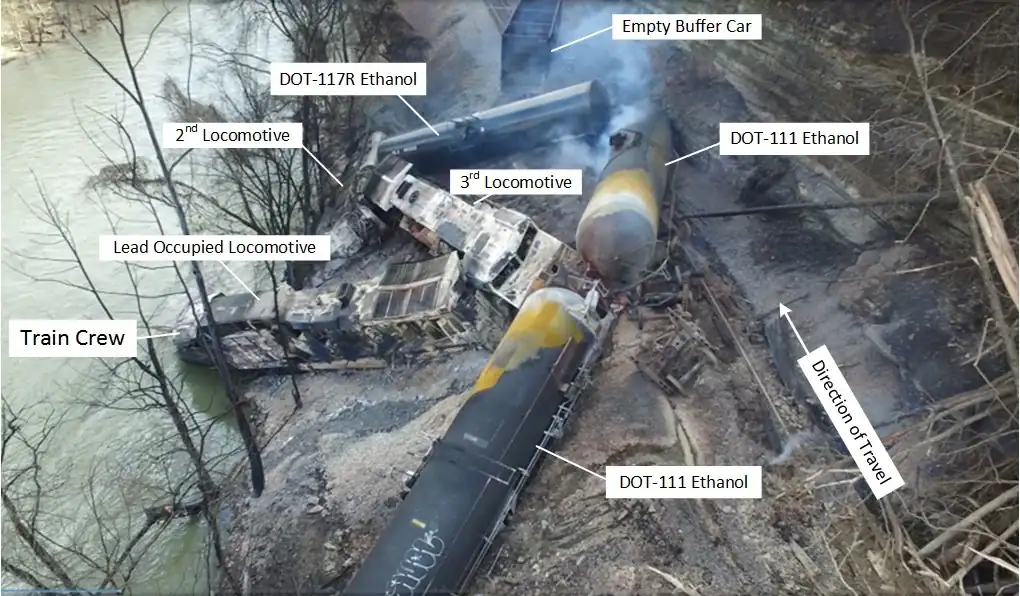
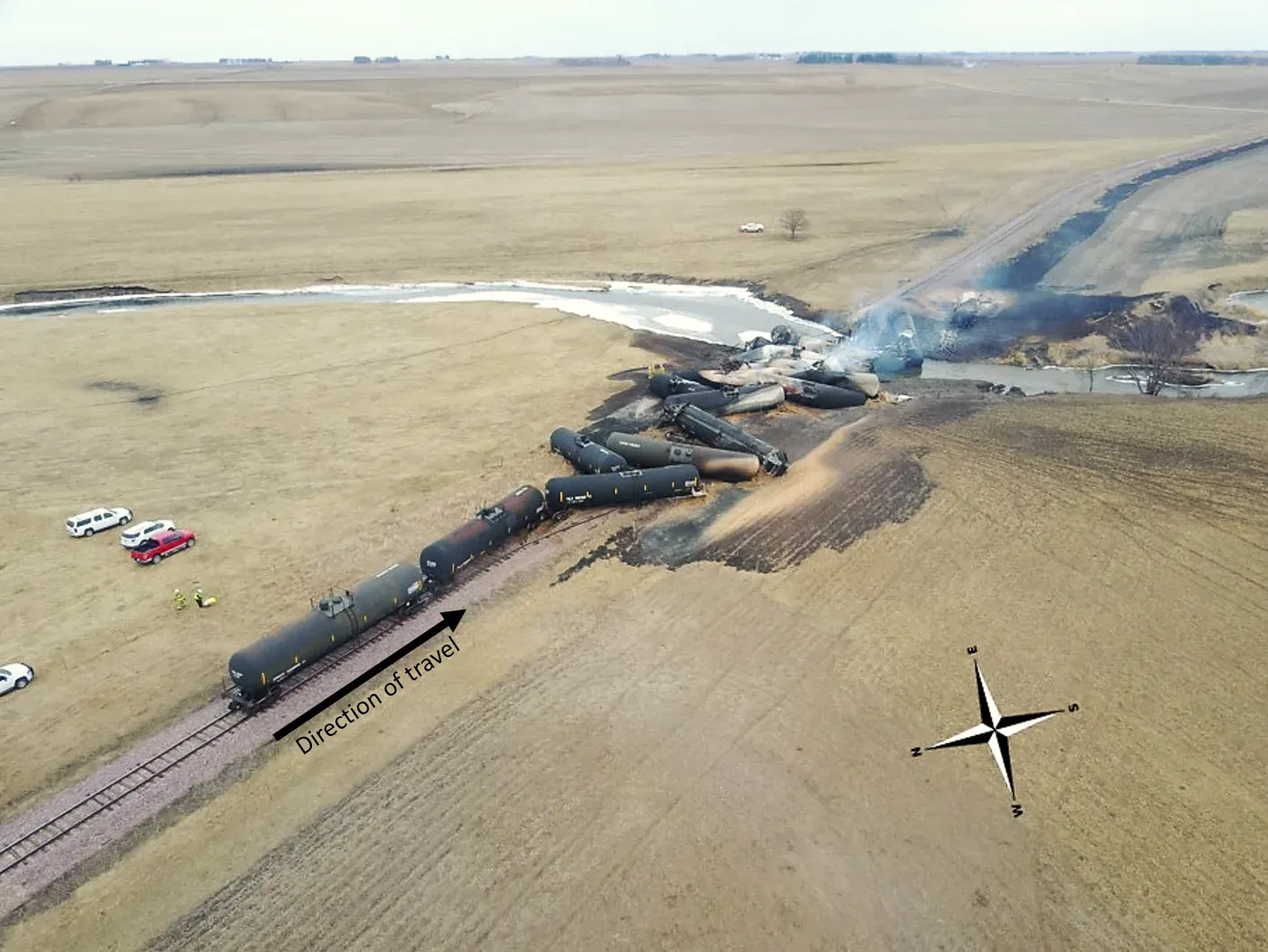
- Bordulac, North Dakota, July 5, 2024. A CPKC train derailed 29 cars, 17 of them hazmat tank cars, after a degraded culvert gave way. Methanol fed a pool fire, and three anhydrous ammonia cars developed thermal tears. In its June 2026 report, the NTSB found that the continued use of DOT-117R cars, retrofits that keep their thinner original shells, “has not resulted in the same safety improvements as newly built DOT-117J tank cars.” It asked PHMSA for new thermal-performance criteria for toxic-inhalation cars and for rules separating them from flammable cars.
- Richmond, Texas, March 18, 2026. A Union Pacific train derailed 24 cars. Of 16 ethanol tank cars, seven breached: two new DOT-117Js and five 117R retrofits, releasing about 120,000 gallons (NTSB preliminary information).
- Wartburg, Tennessee, June 11, 2026. The Fort Wayne–Chattanooga train described at the top of this guide. All 19 derailed hazmat cars were 117Js or 117Rs; two retrofits and one new car breached (NTSB preliminary report, via the Morgan County News).
The 2029 deadline is tight
The BTS 2026 progress report, which covers 2025, counted 100,485 tank cars carrying flammable liquids. Of those, 76,715 (76%) were DOT-117s or 117Rs, up from 73% a year earlier, and 9,596 DOT-111s and 7,487 CPC-1232s were still in service. No DOT-111s were carrying crude oil or ethanol.
The cars that remain mostly haul everything else: other Class 3 liquids in packing groups II and III, such as some fuels, solvents and resins, which can stay in older cars until May 1, 2029. About 17,000 cars are in that position. Retiring or retrofitting all of them would take roughly 4,250 a year, and car shops projected about 2,800 conversions for 2026. At that pace the deadline will be hard to meet, and the law lets the Secretary of Transportation extend it to 2031 if shop capacity falls short. One more detail from the report: the number of 117R retrofits in service dropped slightly in 2025, the first decline since 2022.
Where federal rail safety rules stand going into 2027
Most of the rail safety changes proposed after East Palestine have not become law, and the regulatory direction since 2025 has been to loosen rules rather than tighten them.
- NTSB recommendations. The East Palestine report asked PHMSA to speed up the DOT-111 phase-out, set a schedule for every non-pressure hazmat car to meet DOT-117 standards, widen the definition of a high-hazard train and add vent-and-burn guidance to the ERG. None of its recommendations had been closed as of the NTSB’s February 2025 status update.
- PHMSA. A January 2026 final rule on fuel transportation dropped the tank car pieces of its proposal, and an August 2026 rule removed the requirement that railroads report local hazmat restrictions to the industry’s Bureau of Explosives. No rule adopted in 2025 or 2026 has made tank car standards stricter.
- Wheel bearing detectors. After East Palestine, the railroads committed voluntarily to space hot bearing detectors an average of 15 miles apart on key routes and to stop and inspect when a reading is 170°F above ambient. There is still no federal rule on detector spacing or alarm thresholds.
- Two-person crews. FRA’s 2024 rule requiring at least two crew members, with few exceptions for high-hazard trains, was upheld by the 11th Circuit in August 2026.
- Congress. The Railway Safety Act of 2023 died without a floor vote. Its successor, S. 3903, introduced in February 2026, would move the final DOT-117 deadline up to December 31, 2027, set detector spacing in law and treat a train with five or more flammable gas cars as high-hazard. East Palestine’s train, with its five vinyl chloride cars, would have qualified. It and the House versions remain in committee.
Getting the train consist in the first hour
A train consist is the list of every car in a train, in order from the locomotive, with each car’s reporting marks and whether it is loaded. For hazmat cars it adds the shipping name, UN number, hazard class and emergency response information. The crew carries a paper copy. The consist turns “several tank cars on fire” into a plan.
At East Palestine it arrived late. The NTSB’s final report lays out the timeline:
- 8:56 p.m. The first 911 call reports the derailment and fire.
- Shortly before 10 p.m. Norfolk Southern emails the consist to the Columbiana County EMA, about an hour after the derailment. The fire department’s deputy chief gets the information “by word of mouth.”
- In the meantime, a hazmat technician from East Liverpool pulls the consist up on a phone through AskRail. Responders from Beaver County, Pennsylvania, can’t get into AskRail until about 2 a.m.
The NTSB found that the delay “needlessly increased” the exposure of responders and the public and delayed the evacuation order. A CDC and ATSDR survey of East Palestine responders found that 70% to 90% of those in the main response roles wore no respirator. Of the responders who reported symptoms, 82% reported ear, nose or throat symptoms.
What the 2024 consist rule changed
PHMSA’s real-time train consist rule, published in June 2024, requires every railroad carrying hazmat to keep an accurate electronic consist off the train, update it before the train moves after any change, and be able to push it to authorized responders along the route. After an accident, the railroad must immediately call the primary 911 center (the PSAP) for the area and then send the consist electronically. It must also test its notification system once a year. Class I railroads had to comply by June 24, 2025, though an enforcement discretion notice gave those that asked one more year. Regional and short-line railroads had until June 24, 2026. Both dates have now passed.
The rule only helps if the 911 center knows what to do when the railroad calls. Who takes that call at 3 a.m.? Where does the consist go? How does it reach the first-due officer’s phone or tablet? Those questions belong in your dispatch procedures and your next exercise, and they are exactly the kind of thing VPC’s Incident Command and Emergency Operations workshop for municipal and public employees is built to work through.
A first-hour sequence for a derailment with tank cars
- Approach from upwind, uphill and upstream, and stage well back. Read placards and stencils with binoculars before anyone gets close.
- Find the crew. The conductor has the paper consist, and the crew can tell you what they saw.
- Call the railroad. Every public crossing has a blue Emergency Notification System sign with the railroad’s 24-hour number and a crossing ID that pinpoints your location. Ask for the consist and the railroad’s hazmat response.
- Pull the consist in AskRail if you are registered, or have dispatch request it. Expect to hear from the railroad through your 911 center under the 2024 rule.
- Match the paper to the pile. Derailed cars end up out of order, so confirm each car by its reporting marks before trusting its position in the consist.
- Look up every UN number in the ERG, apply the largest isolation distance, and decide on shelter or evacuation early. If a tank car is in a fire, use the fire distance.
- Call for help sooner than feels necessary: your regional hazmat team, CHEMTREC, the state, and the National Response Center. The AP and Howard Center investigation found specialized hazmat teams took more than an hour to reach East Palestine.
- Build unified command with the railroad and bring the shippers’ technical experts in. That last step comes up again below.
AskRail is the railroads’ free app for emergency responders. It shows a car’s contents by its ID, the whole train consist, a map with mileposts, crossings, schools and hospitals, and the ERG. Access comes through railroad-sponsored or SERTC training, or through a railroad enrolling local responders directly; 911 centers and CHEMTREC also have it. The industry’s figure that 2.3 million responders “have access” counts access through dispatch centers. It doesn’t mean 2.3 million people have the app on their phones. Register your officers before you need it.
BLEVEs, heat-induced tears and how far to pull back
A boiling liquid expanding vapor explosion (BLEVE) is the failure everyone remembers. In ERG2024’s words, it “occurs when a fire impinged or damaged tank car fails to contain its internal pressure and explodes with a sudden product release.” It is most associated with pressure cars carrying liquefied gases such as propane, and it can happen to a damaged pressure car “even in the absence of an active fire.”
The ERG lists four hazards: the fireball, its radiant heat, the blast and flying pieces of the tank. At about four times the fireball’s radius, the radiant heat can burn exposed skin in two seconds. The projectiles reach farthest, and they tend to fly off within 45 degrees on either side of the tank’s ends. For liquefied petroleum gas, the ERG gives these figures for a tank with no thermal barrier and no water spray:
| Tank size | Minimum time to failure (severe torch fire) | Fireball radius | Minimum evacuation | Preferred evacuation | Cooling water |
|---|---|---|---|---|---|
| 21,662 gal (82,000 L) | 8 min | 315 ft (96 m) | 4,708 ft (1,435 m) | 7,218 ft (2,200 m) | 736 gpm |
| 36,984 gal (140,000 L) | 9 min | 374 ft (114 m) | 5,627 ft (1,715 m) | 7,218 ft (2,200 m) | 962 gpm |
Eight minutes is not much. In Kingman, Arizona, in July 1973, a propane tank car BLEVE’d about 20 minutes after the fire department was called. It killed 13 people, 11 of them firefighters. Thermal protection is the reason modern cars buy more time. The ERG says a thermal barrier can cut the heat reaching a tank by a factor of ten or more, which gives the relief valve time to vent before the steel weakens.
Non-pressure cars of crude oil or ethanol fail differently. A heat-induced tear opens along the top of the tank as the metal softens and pressure builds, venting liquid and vapor at high speed into a fireball. Fragments are rarer than with a BLEVE. Timing is the danger. The ERG notes that heat-induced tears have happened within 20 minutes of a derailment and as long as 10 or more hours after the fire began, so a quiet stretch of hours isn’t a reason to move closer.
Practicing those decisions with live readings is hard without live product. VPC’s SYGNAL-enhanced HazMat and HAZWOPER training uses app-based gas meter simulation, so every student watches readings change as they approach a simulated release and has to decide how to isolate, deny entry and escalate.
Vent and burn, a 13-minute decision at East Palestine
On February 3, 2023, Norfolk Southern train 32N, three locomotives and 149 cars, derailed 38 cars in East Palestine, Ohio. A wheel bearing on the 23rd car had overheated. Eleven derailed tank cars carried hazardous materials, including five DOT-105J300W pressure cars of vinyl chloride. A punctured DOT-111 most likely started the fire, which eventually involved 35 railcars. Nobody was hurt in the derailment itself.
The detectors saw the bearing heating up. The NTSB report lists the readings: 38°F above ambient at Sebring, 103°F at Salem about 20 miles before the derailment, and 253°F at East Palestine, the device’s maximum, which finally triggered a critical alarm to the crew. At the time Norfolk Southern’s critical threshold was 200°F above ambient. It has since lowered it to 170°F. The NTSB noted that wayside detectors read below a bearing’s true temperature, and asked FRA to research thresholds and spacing.
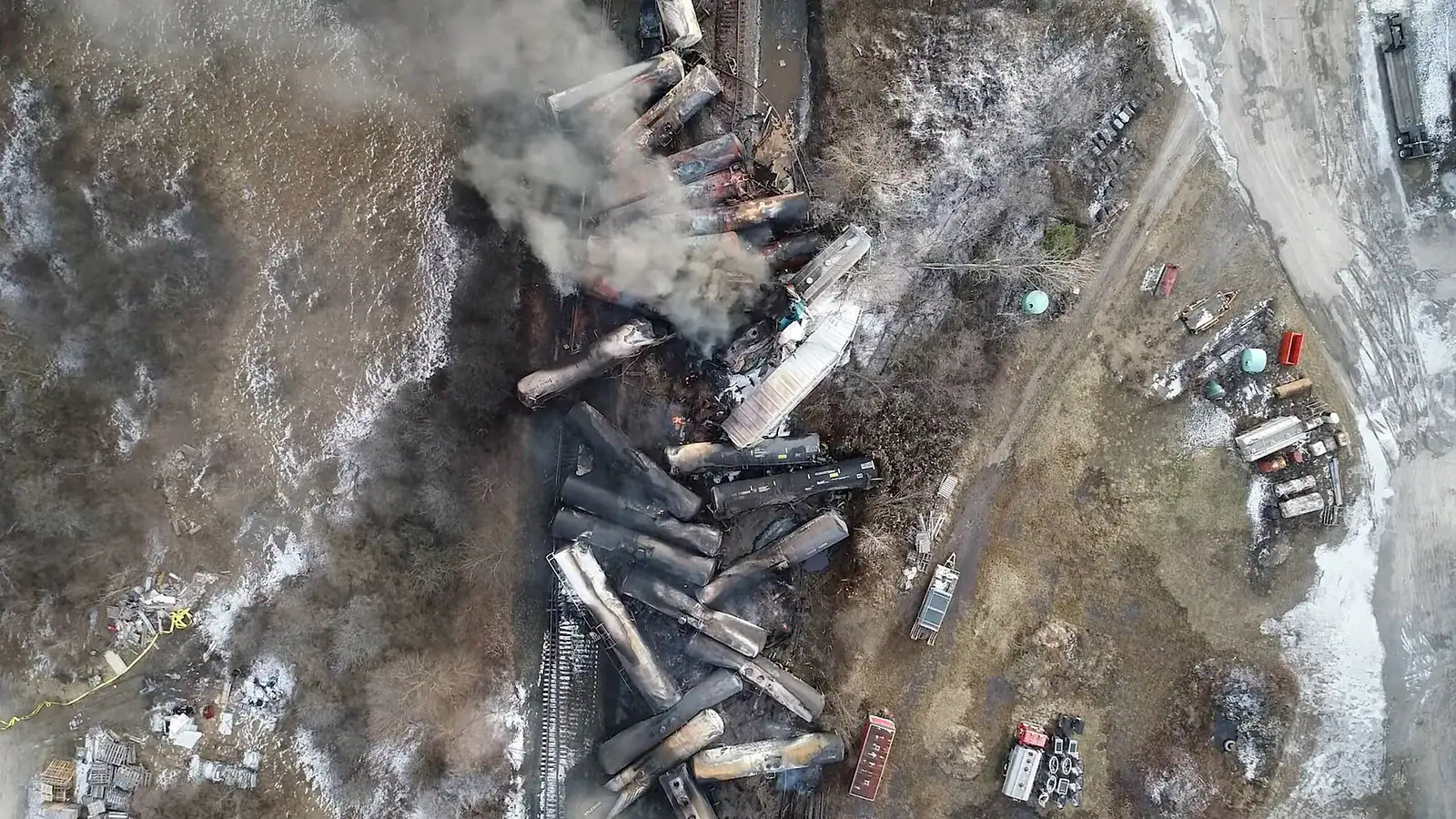
The decision that defined the incident came three days later. The railroad’s contractors told the incident commander that rising temperatures in one vinyl chloride car meant the product was polymerizing and the cars could explode, and that venting all five and burning the contents was “the only remaining option.” The NTSB found otherwise:
- Oxy Vinyls, which loaded the cars, had told the contractors on February 5 that polymerization was not occurring. Oxy was not invited to the February 6 meeting where the decision was made, and the incident commander didn’t know Oxy disagreed.
- The temperature range the contractors cited as a sign of runaway polymerization appears in no written guidance. The car’s temperature was actually falling, to about 126°F by that afternoon.
- After the fact, investigators found no polymer in any of the cars’ pressure relief devices.
- The incident commander had 13 minutes to decide. The charges went off at 4:37 p.m. on February 6.
The NTSB concluded that the vent and burn “was not necessary,” and listed the failure to pass along expert, dissenting opinions as a contributing factor in the severity of the release. Its recommendations went to the railroad, to Oxy Vinyls, to fire service associations and to Ohio. It asked Ohio to require NFPA 1010 training for volunteer firefighters.
That is an incident command problem more than a chemistry problem. Unified command exists to put the people with the expertise in front of the person making the call. A technical specialist position, a planning section that tracks competing recommendations, and an incident commander who asks “who disagrees, and have we heard from the shipper?” before an irreversible decision are all things that can be trained. VPC’s Incident Command Training for Senior Leadership and Incident Command System position-specific training work through exactly those roles.
East Palestine’s other numbers are worth knowing accurately, because many articles get them wrong. A one-mile shelter-in-place came first; the one-mile evacuation was ordered around 11 p.m. that night and lifted at 5:28 p.m. on February 8. The often-quoted one-by-two-mile zone came from the Ohio and Pennsylvania governors’ order before the vent and burn, not from the NTSB. Norfolk Southern has paid the $600 million class-action settlement, with the final $285 million in March 2026. The $310 million settlement with the Justice Department and EPA, announced in May 2024, still had not been entered by the court as of the railroad’s October 2026 quarterly filing.
When patients reach the hospital before the consist does
Hospitals rarely get a call before the first patients walk in. In Graniteville, South Carolina, in January 2005, a Norfolk Southern train hit a parked train and breached a chlorine car. Nine people died, about 5,400 were evacuated, and 554 people went to hospitals, 75 of whom were admitted. In Paulsboro, New Jersey, in 2012, about 20,000 gallons of vinyl chloride escaped and 28 residents sought medical care. The NTSB faulted the incident commander there for failing to follow established hazmat response protocols.
For a hospital within a few miles of a rail line, a derailment raises several problems at once: self-referred, possibly contaminated patients at the door; a decision about sheltering in place or evacuating if the facility sits inside the isolation zone; and staff who can’t get in or get home. VPC’s hospital courses are built for those problems:
- 4-Hour First Receiver HazMat Refresher and 8-Hour First Receiver HazMat Operations for healthcare employees who take part in decontamination operations, including directed self-decon and how to isolate the scene and deny entry.
- Hospital Incident Command System (HICS) courses, where the intermediate class covers mass decontamination alongside incident action planning.
- Advanced Disaster Life Support (ADLS), which has students demonstrate casualty decontamination and protective equipment skills with simulated patients.
- Animal HazMat First Receiver training. People don’t leave service animals or pets behind willingly, and many East Palestine evacuees left cats at home, as we wrote at the time.
- Evacuation Plan Review, Audit, and Drill, including the decision to shelter in place or evacuate.
- Healthcare Coalition training, exercises, and planning, so a rural hospital near the tracks isn’t working out patient distribution on its own.
Responders need looking after too. With most East Palestine responders working without respirators, exposure tracking and follow-up matter. So does the psychological load of a long incident in your own town. Assisting individuals in crisis and group crisis intervention training prepares peers to support each other in the weeks afterward.
Talking to a town that can see the smoke
Residents usually know something is wrong before officials say anything. They can see the smoke and smell the air, and their phones are full of other people’s guesses. When we looked at East Palestine in 2023, in how Crisis and Emergency Risk Communication training helps local leaders, especially in small towns, the mayor had told a reporter, “We don’t have media training, we’re a small little Ohio town.”
People trained in CERC know never to make promises they can’t keep.
Joel Heavner, VPC CERC instructor, 2023
The hardest messages in a rail incident tend to come in a predictable order. First there is the early shelter-or-evacuate instruction, which has to reach people who don’t follow the city’s social media. Next comes the explanation of a decision like vent and burn while it is still uncertain. Last comes the all-clear, which people will doubt if test results come out unevenly or if railroad workers are seen being pulled from the area. Crisis and Emergency Risk Communication (CERC), developed by the CDC, is a proven, psychology-based system for exactly those moments. Students practice writing a news release, giving interviews and running a press conference. Elected officials, public information officers and hospital spokespeople all benefit, because they will all be asked the same questions on the same day.
Planning for the train before it derails in your county
Most of the work that helps on the night of a derailment happens months earlier, and much of it runs through your Local Emergency Planning Committee (LEPC).
- Commodity flow studies. Railroads will share the hazmat commodities they carry through your area with emergency planners on written request, confidentially, under the industry’s Circular OT-55. A commodity flow study combines that with highway counts. Clark County, Indiana, completed one in 2023, and Allen County approved one in December 2023. If your county’s is more than a few years old, it predates the shift from crude to ethanol.
- Hazard mitigation plans. A rail corridor belongs in your multi-hazard mitigation plan, with the schools, nursing homes and water intakes within a mile of the tracks identified ahead of time.
- Grants. PHMSA’s Hazardous Materials Emergency Preparedness (HMEP) grants sent about $23.4 million to states and territories for fiscal 2026, and states pass much of it to LEPCs for planning and training. Our Midwest Hazmat Technician post lists other sources, including ALERT grants and CHEMTREC’s HELP awards.
- Free rail training. The Security and Emergency Response Training Center (SERTC) in Pueblo, Colorado, runs FEMA-funded courses at no cost to responders, including a Tank Car Specialist course. TRANSCAER brings training tank cars to local departments.
- Standards. NFPA 470 consolidated the old NFPA 472, 473 and 1072 hazmat responder standards. The next edition is due in 2027, so it is a good time to check your training levels against it. VPC’s HazMat and HAZWOPER courses, from Awareness and Operations through the 80-hour Hazardous Materials Technician course, include the curriculum set by Indiana as well as the state exam.
Pre-planning, policies and procedures, response and incident management training, and some basic equipment can make a huge difference on any given response in the future.
Jamey Burrows, VPC HazMat Branch Director, 2023
A deadline for Indiana and Ohio: the Union Pacific–Norfolk Southern merger
Union Pacific announced plans to acquire Norfolk Southern in July 2025, and the Surface Transportation Board is reviewing it under docket FD 36873. Under the board’s August 2026 schedule, comments, protests and requests for conditions are due November 18, 2026. Norfolk Southern is one of Indiana’s main hazmat carriers, so state agencies, LEPCs and local officials who want safety or emergency-planning conditions on the deal have a short window to put them on the record.
Ohio passed its own rail law in 2023, requiring wayside detectors every 10 to 15 miles and alerts to the crew; the railroads challenged it in court. Indiana hasn’t passed anything comparable. A 2025 bill to cap train length at 8,500 feet died.
A rail tank car tabletop exercise for your county
This scenario is fictional, built from the incidents above. It is a starting point for a discussion-based exercise of three or four hours. Put the people who would actually make these decisions in the room: the fire chief and hazmat team, the 911 center, EMA, law enforcement, public works, the school district, the hospital and healthcare coalition, the health department, elected officials and their public information officer, and someone from the railroad. LEPCs have to exercise their hazmat plans anyway, as four northeast Indiana counties did in the joint HazMat drill VPC planned and evaluated.
Setting. 2:40 a.m. on a January weeknight. 18°F, wind from the northwest at 12 mph. A mixed-freight train derails 22 cars at a grade crossing on the edge of a town of 4,000. An elementary school sits 400 yards downwind and a nursing home half a mile away. A DOT-111 car of a flammable liquid is burning. Two DOT-105 pressure cars placarded 1075 are derailed beside it, and a DOT-117R ethanol car is on its side nearby.
Module 1: the first 30 minutes
- The first-due engine reports “several tank cars, one on fire.” The crew has walked to the crossing with the paper consist. What does the officer do first, and from where?
- Who calls the railroad, using which number? Does your 911 center know what to do when the railroad calls it under the 2024 consist rule, and where does that consist go?
- Which ERG guides apply, and which isolation distance wins? Do you shelter or evacuate the nursing home, and who makes that call?
Module 2: hour one to hour six
- The pressure relief valve on one LPG car begins venting and flaring. What does that tell you, and does it change your distance? Check the ERG BLEVE table.
- The regional hazmat team is 70 minutes out. What can local crews do defensively until then?
- The hospital 12 miles away has nine walk-in patients with coughing and eye irritation, and two arrived by private car still wearing their clothes from home. When does it activate HICS and set up decon?
- A television crew is at the roadblock, and a post claiming “toxic cloud headed for the high school” has 2,000 shares. Who speaks, and what do they say in the first statement?
Module 3: day two and three
- The railroad’s contractor proposes an irreversible step to deal with the damaged cars, and the shipper’s chemist disagrees on a phone call that only one person in command heard. How does that disagreement reach the incident commander?
- Residents want to go home. What has to be true before you lift the evacuation, who tests the air and water, and how do you explain results that are still coming in?
- Responders worked the first night without respirators. Who tracks their exposure, and who offers crisis support to them and their families?
An outline like this becomes a full exercise when it has objectives tied to your capabilities, an evaluator and an after-action report, which is what an HSEEP consistent exercise provides. Our post on the Clade X exercise explains why scenarios with no clean answer are often the most useful ones to run.
Rail tank car questions responders ask
A rail tank car is a steel tank on a railcar frame built to carry liquids or gases in bulk. Capacities run from about 6,500 to more than 30,000 gallons. They come in two main families: non-pressure (general service) cars for liquids such as crude oil and ethanol, and pressure cars for liquefied gases such as propane, chlorine and anhydrous ammonia.
A new DOT-117 has a thicker 9/16-inch steel shell, full-height head shields, thermal protection under a steel jacket, protected top fittings and a bottom outlet handle that is removed or locked out in transit. A DOT-111 typically has a 7/16-inch shell, and those protections are optional. A DOT-117R is a retrofitted older car that keeps its thinner shell.
DOT-111s left crude oil service in 2018 and ethanol service on May 1, 2023. Every DOT-111 and CPC-1232 still carrying other flammable liquids must be retired or upgraded by May 1, 2029. Federal law allows an extension to 2031 if shop capacity falls short, and about 17,000 cars were still affected at the end of 2025.
A train consist lists every car in a train in order, with the contents, UN number, hazard class and emergency information for each hazmat car. The crew carries a paper copy. Under PHMSA’s 2024 rule, railroads must also keep it electronically, push it to authorized responders and notify the local 911 center after an accident. Registered responders can pull it in AskRail.
ERG2024 says to isolate a rail tank car involved in a fire for one mile (1,600 m) in all directions if it carries a flammable gas such as propane or vinyl chloride, or anhydrous ammonia, and to consider evacuating that far. For crude oil, ethanol and chlorine the fire distance is half a mile (800 m). The ERG’s LPG BLEVE table gives larger distances for a tank that may fail.
The stencil is the surest sign: pressure cars start with 105, 112 or 114, general service cars with 111 or 117. A pressure car keeps all its valves under one bolted housing on top, and DOT-105 and 112 cars have no bottom outlet. Newer general service cars have top housings too, so a bottom outlet valve is the better visual clue. Confirm with the placard and consist.
Paint color isn’t part of most tank car specifications, so it is not a reliable clue to the contents. The one firm rule: a pressure car in compressed-gas (Class 2) service without thermal protection or insulation must have the upper two-thirds of the tank painted reflective white. Read the placard and stencil instead.
AskRail is the railroads’ free app for emergency responders. It shows what is in a rail car by its ID, the full train consist, a map of the area with schools and hospitals, and ERG guidance. Responders usually gain access through railroad-sponsored or SERTC training, and 911 centers and CHEMTREC can use it too.
No, according to the NTSB. Its 2024 report found the vinyl chloride was not polymerizing, temperatures were falling, and the shipper’s experts had said so, but their view never reached the incident commander, who had 13 minutes to decide. The NTSB called the vent and burn unnecessary.
Sources
- NTSB, Norfolk Southern derailment and hazmat release, East Palestine, Ohio (RIR-24-05, corrected)
- NTSB, CPKC derailment, Bordulac, North Dakota (RIR-26-07)
- BTS, Progress Toward Safer Rail Tank Cars Transporting Flammable Liquids: 2026 Report
- FRA rail equipment accident data (Form 54)
- EIA, movements of crude oil and selected products by rail
- PHMSA, Emergency Response Guidebook (ERG2024)
- AAR, Field Guide to Tank Cars (2022)
- 49 CFR Part 179, tank car specifications
- PHMSA, real-time train consist information final rule (2024)
- CDC/ATSDR, East Palestine Assessment of Chemical Exposures (2023)
- AP and Howard Center, derailment preparedness investigation (2025)
- WISH-TV, “Daily danger travels Indiana railways” (2023)
Train the people who will be on that pile of cars. VPC’s hazmat trainers include Larry Hamby, a former hazardous materials specialist with the Indiana State Fire Marshal’s Office. We deliver HazMat, incident command, hospital first receiver and crisis communication training on-site across Indiana and the Midwest, and we build rail exercises around the traffic your county actually sees.
Request trainingThe scrolling train and terminal images are cut from New York State’s 2021 aerial orthoimagery of the Port of Albany, courtesy of NYS ITS Geospatial Services. Accident photos are public-domain NTSB images via Wikimedia Commons.